
What Is the Best Facial Analysis Machine in 2026?
Choosing the best Facial Analysis Machine in 2026 requires more than comparing camera resolution or software claims. Clinics now assess hydration, pores, pigmentation, redness, texture, and facial symmetry within minutes. A useful device should produce repeatable images under controlled lighting. It should also explain how each score is calculated. Marketing language can sound impressive. It is not evidence. In practice, a clear baseline often matters more than a dramatic graphic.
Experienced aestheticians and dermatology professionals usually examine workflow, sensor quality, database design, and reporting accuracy. A machine that takes sharp images but gives inconsistent readings may confuse treatment planning. Look for cross-polarized lighting, adjustable positioning, skin-tone testing, and secure data handling. Independent validation is valuable, especially when a device compares results across months. However, published studies may use small samples. That limitation deserves attention. A confident score is not a diagnosis.
This guide compares leading systems through practical clinic scenarios, not showroom promises. It considers setup time, maintenance, training, customer comfort, and total ownership cost. A busy clinic may prefer speed. A specialist may value deeper analysis. Neither choice is automatically best. Even advanced software can misread makeup, dehydration, or uneven lighting. Human review remains essential. The strongest purchase combines measurable performance, professional judgment, and honest expectations. Some conclusions may remain uncertain, and that is worth admitting.
What Is a Facial Analysis Machine and How Does It Work?
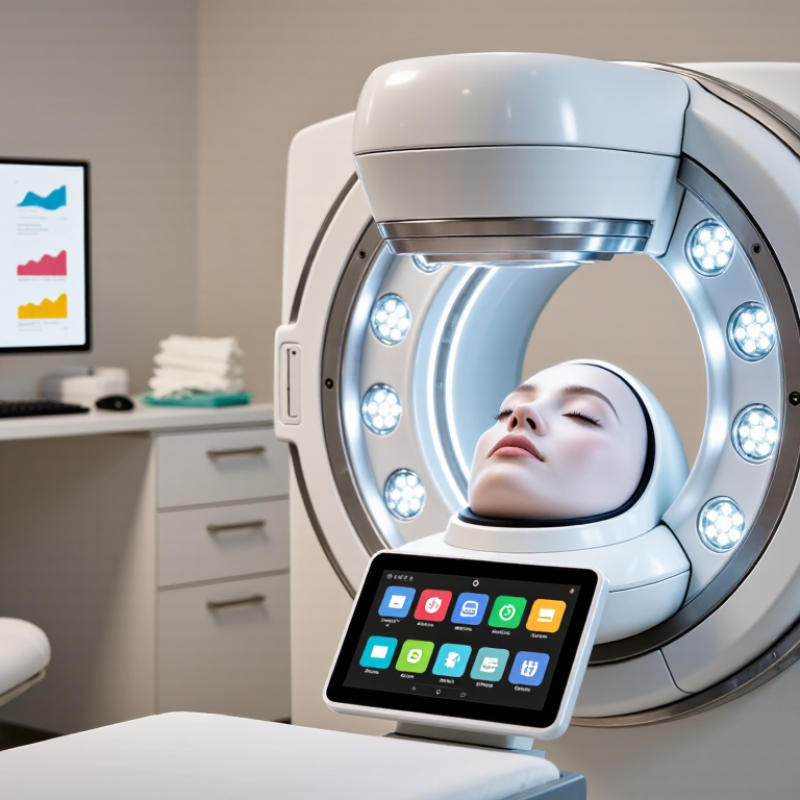
A facial analysis machine captures detailed images of the skin and converts visible features into measurable data. It may examine pores, wrinkles, redness, pigmentation, oiliness, and texture. Some systems use controlled lighting, polarized images, or multiple light wavelengths. The device then compares image patterns with programmed reference data. Its software produces scores, maps, or visual reports.
The process is not magic. A trained operator usually cleans the face, controls lighting, and positions the subject consistently. Small changes can affect the result. Makeup, recent exercise, dehydration, and room temperature may also influence readings. In my experience, the most useful machines make changes easy to compare over time. They should support professional observation, not replace it. A report is an estimate, not a medical diagnosis. Even reliable equipment can miss context, and that limitation deserves attention.
Tips: Use the same room, lighting, camera distance, and facial position during each scan. Remove makeup and record recent skincare use. Ask how the system was tested and calibrated. Check whether its recommendations match your skin’s real condition, not only its score. Better data helps, but human judgment still matters.
Which Features Define the Best Facial Analysis Machine in 2026?
What Is the Best Facial Analysis Machine in 2026?
The best facial analysis machine should turn visible skin changes into reliable, repeatable measurements. Demand is expanding quickly. The ISAPS 2023 Global Survey recorded more than 34 million surgical and nonsurgical aesthetic procedures worldwide. That growth increases the need for evidence, not attractive screens.
High-resolution imaging is only the starting point. A strong system should combine polarized, ultraviolet, and cross-polarized lighting. These modes can reveal redness, pigmentation, pores, texture, and surface oil more clearly. The Global Wellness Institute valued the global wellness economy at $5.6 trillion in 2022. This figure shows the market’s scale, but it does not prove every device works equally well.
Clinical validation matters more than a long feature list. Look for studies comparing results with dermatologist assessments or validated instruments. The system should control room lighting, camera distance, facial expression, and skin position. Otherwise, a small lighting change may look like real improvement. Data security also deserves attention, including consent controls, encrypted storage, and clear deletion policies.
I would question any machine promising instant diagnosis. Facial analysis can support consultation, but it should not replace professional judgment. No device is perfect. Skin tone, cosmetics, dehydration, and recent treatments can distort readings. A useful machine reports uncertainty, preserves raw images, and supports consistent follow-up instead of forcing confident conclusions.
How Do Leading Facial Analysis Machines Compare?
What Is the Best Facial Analysis Machine in 2026?
How Do Leading Facial Analysis Machines Compare?
Leading facial analysis machines differ less by appearance than by measurement quality. Some use polarized light, cross-polarized imaging, or multispectral cameras. These methods can reveal redness, pigmentation, texture, pores, and moisture changes. However, results depend heavily on lighting, camera distance, and operator training. A reliable system should provide repeatable images, clear scoring methods, and evidence from independent testing.
Clinical usefulness matters more than impressive graphics. The best platforms separate visible concerns from predictive estimates. They should explain uncertainty instead of presenting every number as fact. Privacy controls are also essential, especially when storing facial images. In practice, trained professionals should combine machine readings with medical history and direct observation. A polished score can still mislead. Skin changes with sleep, temperature, cosmetics, and recent treatments. No device captures the entire story.
Tips: Compare the same face under identical lighting and positioning. Ask whether the system has published validation data. Check calibration schedules and staff training requirements. Record measurements over time, rather than trusting one scan. Review doubtful findings with a qualified skin professional. I would also question unusually precise results; accuracy is not always improved by more decimals.
What Factors Should Clinics Consider Before Choosing a Machine?
What Is the Best Facial Analysis Machine in 2026?
Clinics should begin with purpose, not appearance. A machine that captures attractive images may still provide weak clinical value. Define the intended use, such as hydration assessment, pigmentation mapping, pore analysis, or treatment progress tracking. Each measurement should have understandable methods and supporting evidence. Ask whether independent studies support its accuracy across different skin tones and ages.
Test the system with real patients before purchasing. Include oily, dry, sensitive, mature, and deeply pigmented skin. Compare readings under controlled lighting and repeat the scan after a short interval. Consistent results matter more than impressive screen graphics. A small variation may be acceptable, but unexplained changes require investigation. Clinics should also examine image resolution, software updates, data storage, and patient consent procedures.
Workflow deserves equal attention. The scan should fit comfortably into consultation time and produce reports staff can explain clearly. Training must be practical, with guidance for positioning, lighting, and cleaning. Check service response times, warranty terms, calibration requirements, and the full ownership cost. The cheapest machine may become expensive when software, repairs, or staff training are added. It is easy to overvalue novelty. I would also question my own preference for advanced features, because unused functions create clutter rather than better care. A careful trial often reveals inconvenient weaknesses. That is useful information.
What Is the Best Facial Analysis Machine in 2026?
The best facial analysis machine depends on clinical priorities rather than brand name. This transparent evaluation framework assigns a total of 100% importance to the main factors clinics should assess before purchasing.
Measurement validity and repeatability receive the highest weighting because reliable results are essential for treatment planning and progress tracking. Clinics should also review lighting consistency, workflow integration, patient-data protection, total cost of ownership, training, and after-sales support. These percentages are a practical decision model, not a manufacturer ranking.
How Will Facial Analysis Technology Develop Beyond 2026?
Facial analysis will move beyond simple skin scoring after 2026. Future systems may combine visible-light images, near-infrared readings, and 3D surface mapping. This could reveal texture changes around the eyes, uneven tone, and hydration patterns more consistently. The best facial analysis machine will not merely produce attractive charts. It will explain measurement limits, show confidence levels, and support professional judgment. That matters in real consultations, where lighting changes from one room to another.
Artificial intelligence may also track progress across weeks instead of judging one image. A client could receive a clearer timeline, with repeated scans taken under controlled lighting. However, automation will not remove every problem. Different skin tones, facial movements, camera angles, and skincare products can influence results. Some predictions may still be wrong. Professionals should question unusual readings and compare them with direct observation. Independent testing, regular calibration, and transparent data policies will become essential signs of reliability.
Tips: Use the same lighting, camera distance, and facial position during every scan. Ask whether images are processed locally or stored remotely. Check if the system was tested across varied ages and skin tones. Keep human review involved, especially when results seem inconsistent. A machine can detect patterns, but it cannot fully understand a person’s habits, sensitivities, or changing environment.
What Is the Best Facial Analysis Machine in 2026? - How Will Facial Analysis Technology Develop Beyond 2026?
A practical comparison of major facial-analysis technologies, their measurable capabilities, suitable applications, and expected development after 2026. The comparison is technology-based and does not include company or brand data.
| Technology Type | Primary Sensing Method | Typical Capture Time | Main Measurements | Key Strengths | Main Limitations | Best 2026 Use Case | Future Potential |
|---|---|---|---|---|---|---|---|
| Standard RGB Imaging | Visible-light camera with computer-vision and machine-learning analysis | Approximately 1–5 seconds | Visible spots, redness, pore appearance, wrinkles, skin tone distribution, facial symmetry, and texture patterns | Affordable, fast, non-contact, easy to integrate with mobile or clinic workflows, and widely supported by image-analysis software | Results can change with lighting, camera distance, makeup, skin moisture, and image quality; it does not directly measure deeper tissue properties | Routine skin consultations, progress tracking, education, and high-volume retail or clinical screening | High |
| Cross-Polarized Imaging | Visible-light camera combined with cross-polarizing filters to reduce surface glare | Approximately 2–8 seconds | Redness, vascular appearance, pigmentation distribution, uneven tone, and low-contrast surface features | Improves image consistency by reducing specular reflection and can reveal color differences that are difficult to see under ordinary lighting | Still affected by exposure settings and skin preparation; primarily evaluates optical appearance rather than biological activity | Detailed pigmentation and redness assessment, treatment documentation, and before-and-after comparison | High |
| Multispectral Imaging | Several controlled visible and near-infrared wavelength bands captured by calibrated sensors | Approximately 5–20 seconds | Relative pigmentation, erythema, melanin-related patterns, surface condition, and selected subsurface optical indicators | Provides more objective spectral information than ordinary RGB imaging and supports standardized longitudinal measurements | Higher equipment cost, calibration requirements, and results that depend on validated algorithms and controlled acquisition conditions | Professional skin assessment, research-supported cosmetic evaluation, and treatment monitoring | Very High |
| 3D Structured-Light or Depth Imaging | Projected light pattern or depth sensor used to reconstruct facial geometry | Approximately 1–10 seconds | Facial contours, volume, symmetry, surface relief, wrinkle depth, folds, and selected dimensional changes | Captures shape and topography that cannot be reliably measured from a flat photograph; useful for objective geometry tracking | Movement, facial expression, hair, reflective surfaces, and head-position changes can reduce repeatability | Wrinkle-depth assessment, facial contour analysis, aesthetic treatment planning, and volumetric progress tracking | Very High |
| Near-Infrared Imaging | Near-infrared illumination and sensors that detect reflected or partially penetrating light | Approximately 3–15 seconds | Optical differences associated with pigmentation, vascular patterns, hydration-related contrast, and selected subsurface features | Can provide information that is less dependent on visible-light appearance and may improve detection of low-contrast patterns | Interpretation is indirect; measurements require careful calibration and should not be treated as a medical diagnosis without clinical validation | Advanced cosmetic consultation, research, and complementary analysis alongside visible-light imaging | High |
| Fluorescence Imaging | Excitation light and camera detection of emitted fluorescence from the skin surface | Approximately 2–10 seconds | Surface fluorescence patterns, selected porphyrin-related signals, oil-associated areas, and surface irregularities | Highlights features that may be difficult to distinguish under ordinary visible illumination | Signals can be influenced by cleansing, cosmetics, ambient light, and individual skin characteristics; interpretation requires trained users | Surface-condition education, oil-area visualization, and supplementary professional assessment | Specialized |
| Thermal Imaging | Infrared thermal sensor measuring emitted surface temperature patterns | Approximately 5–30 seconds | Relative temperature distribution, thermal asymmetry, and changes associated with surface blood-flow patterns | Contact-free and capable of showing dynamic thermal changes that are not visible in ordinary photographs | Strongly affected by room temperature, airflow, recent exercise, hot or cold drinks, and acclimatization time | Specialized research, complementary inflammation-related observation, and controlled clinical studies | Specialized |
| Hybrid Multimodal Systems | Combination of RGB, polarized, multispectral, depth, or other calibrated sensors in one workflow | Approximately 5–30 seconds | Combined appearance, color, texture, geometry, and selected optical indicators with longitudinal scoring | Offers the broadest information set and can cross-check findings across different sensing methods | Higher purchase and maintenance cost, greater workflow complexity, data-standardization challenges, and a stronger need for user training | Comprehensive professional assessment, clinics with standardized protocols, and high-value treatment planning | Best Overall Potential |
| AI-Assisted Analysis Layer | Machine-learning models applied to images and measurements from one or more sensors | Usually less than 10 seconds after image capture | Feature segmentation, severity scoring, change detection, personalized recommendations, and risk flags for human review | Improves consistency, automates reporting, supports trend analysis, and can combine multiple measurements into an easier-to-read result | Accuracy depends on training data, demographic coverage, image quality, validation methods, privacy controls, and human oversight | Standardized reporting, personalized skincare planning, and longitudinal client monitoring | Core Development Area |