What Is Eco Friendly Plastic and Why Does It Matter?
Plastic is woven into daily life, from food trays and delivery bags to medical packaging. Yet its environmental cost is difficult to ignore. The OECD’s Global Plastics Outlook reports that global plastic waste reached 353 million tonnes in 2019. Only 9% was recycled. Much is burned, buried, or lost into nature.
That is where eco friendly plastic enters the discussion. The term can describe bioplastics, recycled plastics, or materials designed for better recovery. It does not automatically mean harmless. A compostable package may need an industrial composting facility. A bio-based plastic can still require land, water, energy, and careful waste management. The label needs evidence.
European Bioplastics and nova-Institute estimated global bioplastics production capacity at about 2.18 million tonnes in 2023. They project nearly 7.43 million tonnes by 2028. Growth is significant, but small beside conventional plastic production. Scale matters.
So does design.
Ellen MacArthur, founder of the Ellen MacArthur Foundation, has stated, “We need to move from a take-make-dispose model to a circular economy.” Her point remains practical. Better materials cannot solve a waste system alone. Reuse, collection, recycling, and responsible purchasing must work together.
The UNEP Turning off the Tap report suggests plastic pollution could fall sharply by 2040 through reuse, recycling, and redesign. That promise is encouraging, but not guaranteed. Consumers and businesses still need transparent data, credible certifications, and realistic disposal instructions. Eco friendly plastic matters most when it reduces harm across its full life cycle, not merely when it sounds greener.
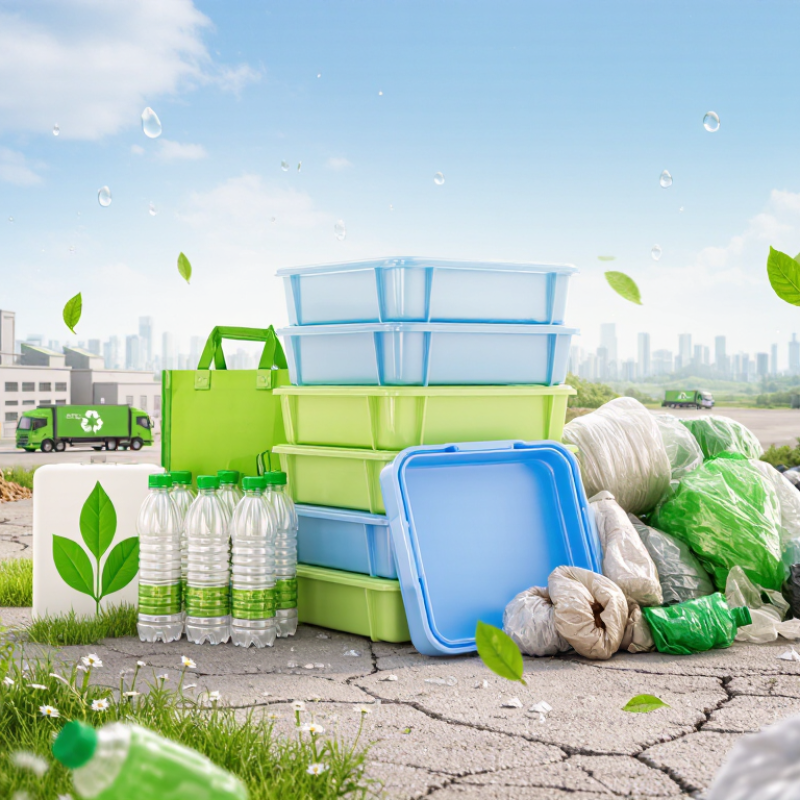
Defining Eco-Friendly Plastic: Types, Materials, and Environmental Criteria
Eco-friendly plastic is not one single material. It describes plastics designed to reduce environmental harm across their life cycle. That life cycle includes raw material extraction, manufacturing, transport, use, and disposal. Some products use recycled plastic, while others use plant-based feedstocks such as corn starch or sugarcane. Plant-based does not always mean harmless. Farming, processing, and transport still create emissions.
Material choice matters, but performance matters too. A durable container may prevent repeated replacements and reduce waste. Recycled content can lower demand for new fossil resources. Compostable plastic needs the right heat, moisture, and microbes to break down properly. In a household bin, it may remain unchanged for years. Environmental criteria should include carbon emissions, water use, chemical additives, recyclability, and verified end-of-life conditions. Labels alone are not enough. Claims can sound greener than the evidence supports.
Tips: Check the recycled-content percentage and disposal instructions. Look for independent testing or recognized environmental standards. Avoid assuming “biodegradable” means it will disappear anywhere. In real packaging assessments, I would also measure weight, shelf life, and transport distance. A lighter package can sometimes outperform a heavier “green” material. This is easy to overlook. No material is perfect, and even careful evaluations may miss impacts hidden in farming, factory energy, or local waste systems.
What Is Eco-Friendly Plastic and Why Does It Matter? - Defining Eco-Friendly Plastic: Types, Materials, and Environmental Criteria
| Plastic Type or Material | Typical Feedstock | End-of-Life Behavior | Potential Environmental Advantage | Important Limitation |
|---|---|---|---|---|
| Recycled PET | Post-consumer or post-industrial PET waste | Generally recyclable where PET collection and processing systems exist | Uses existing plastic material and can reduce demand for virgin resin | Quality can decline after repeated recycling; collection rates and contamination affect results |
| Bio-based PE | Renewable biomass such as sugarcane-derived ethanol | Chemically similar to fossil-based PE and generally not biodegradable | Can reduce fossil feedstock use when responsibly sourced | Still persists in the environment and may compete for land or create agricultural impacts |
| Bio-based PET | Partly renewable plant-derived inputs combined with conventional chemical components | Usually recyclable within PET recycling systems; not normally biodegradable | May lower reliance on fossil resources while retaining familiar performance | Bio-based content may be partial, and agricultural sourcing must be assessed |
| PLA Polylactic acid |
Fermented plant sugars, commonly from crops such as corn or sugarcane | Typically requires controlled industrial composting conditions; does not quickly decompose in nature | Can be made from renewable carbon and is suitable for some compostable packaging applications | Industrial composting access is limited in many regions; contamination can disrupt recycling streams |
| PHA Polyhydroxyalkanoates |
Produced by microorganisms from renewable feedstocks | Some grades can biodegrade in specific soil, freshwater, marine, or composting conditions; performance varies by formulation | Offers biodegradability potential beyond controlled industrial composting for certain applications | Degradation speed and environmental performance depend strongly on product design and disposal conditions |
| Starch-Based Blends | Starch from crops such as potatoes, wheat, or corn, often blended with other polymers | May be compostable only when the complete formulation meets relevant requirements | Can incorporate renewable material and reduce the amount of conventional polymer used | Performance, moisture resistance, biodegradability, and compostability vary widely |
| Recycled HDPE | Recovered high-density polyethylene products and packaging | Potentially recyclable again where suitable collection and sorting systems are available | Reduces the need for virgin HDPE and can divert plastic from disposal | Not all local systems accept every HDPE product; additives and contamination can limit recycling |
| Conventional PE and PP | Fossil-based chemical feedstocks | Generally durable and non-biodegradable; may be recyclable depending on product and local infrastructure | Light weight and durability can reduce transport energy and product damage in some applications | Uses fossil resources and can persist for a long time when mismanaged |
Environmental Criteria for Evaluating Eco-Friendly Plastic
| Evaluation Dimension | What to Examine | Why It Matters |
|---|---|---|
| Feedstock Source | Virgin fossil resources, recycled material, agricultural biomass, or industrial by-products | The source influences resource depletion, land use, emissions, and supply-chain impacts |
| Life-Cycle Greenhouse Gas Emissions | Emissions from raw materials, manufacturing, transport, use, and disposal | A material is not automatically lower-impact simply because it is bio-based or biodegradable |
| Recyclability | Whether the product is accepted, sorted, processed, and converted into usable material in the target market | A theoretical recycling route has little value without accessible collection and processing infrastructure |
| Compostability | Required temperature, humidity, time, and facility type for complete disintegration and biodegradation | “Compostable” generally refers to defined conditions, not rapid breakdown in streets, oceans, or ordinary soil |
| Durability and Reuse | Service life, cleaning requirements, refill potential, and number of safe reuse cycles | A durable product may reduce total material use when it is actually reused enough times |
| Chemical Safety | Additives, coatings, colorants, and the possibility of hazardous substances entering products or waste streams | Environmental performance includes effects on human health, ecosystems, and recycling workers |
| Waste-System Compatibility | Compatibility with local recycling, composting, energy-recovery, and landfill systems | The best option depends on the infrastructure available where the product will be discarded |
| Resource Efficiency | Material quantity, water use, energy demand, production yield, and packaging-to-product ratio | Using less material and avoiding unnecessary packaging can reduce impacts regardless of polymer type |
Key takeaway: Eco-friendly plastic is not a single material category. Its environmental value depends on the feedstock, manufacturing impacts, product lifespan, chemical composition, and the real-world waste-management system available after use.
Related Posts
-
How to Source Eco Plastic for Sustainable Packaging Solutions?
-
Transforming Tomorrow: The Surprising Benefits of Recycled Plastic in Everyday Products
-
Unlocking the Future: Innovative Uses of Recycled Plastic Materials in Everyday Products
-

Innovative Designs and Benefits of Products Made from Recycled Plastic
-

Top 5 Eco Friendly Products Made From Recycled Plastic You Need to Know
-

2025 How to Choose Eco Friendly Plastic Alternatives for a Sustainable Future