
Top CPVC Tee Manufacturers in China
China has a broad market for CPVC fittings, but manufacturers can differ greatly in process control, product range, and technical support. A Cpvc Tee may look simple on a catalog page. Its performance depends on more than appearance: dimensions, socket fit, material consistency, and pressure suitability all matter in service.
This introduction to top CPVC tee manufacturers in China sets out practical points for comparing suppliers. It considers manufacturing capability, quality checks, product documentation, customization, and export experience. Small details count. For example, buyers can ask how a factory controls tee dimensions, checks molded surfaces, and verifies product performance against the stated specifications. Clear answers are more useful than broad claims.
The right supplier depends on the application, order volume, and required standards. A manufacturer suitable for one project may not suit another. That is worth remembering. Buyers should confirm material grades, operating conditions, available test reports, and delivery terms before placing an order. Requesting samples can also reveal socket finish and dimensional fit, though a sample alone cannot prove consistent production quality. This guide offers a starting point, not a substitute for technical review. Careful comparison helps buyers identify Chinese manufacturers whose capabilities and documentation match their needs, while leaving room to question claims that are difficult to verify.
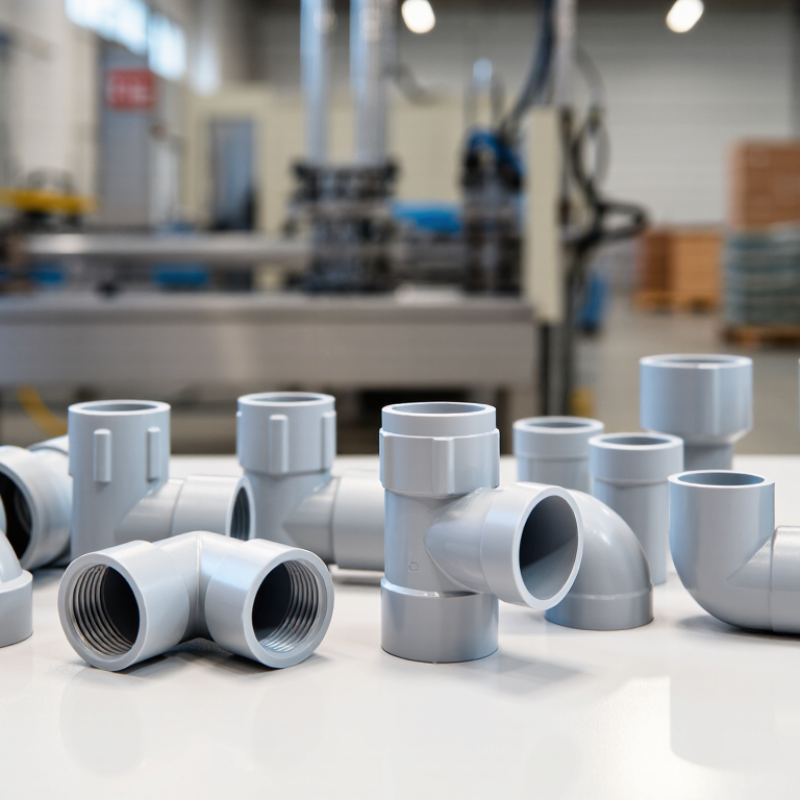
CPVC Tees in Context: 90° Branch Design and ASTM F439 Schedule 80 Fittings
A 90° CPVC tee looks simple, but its branch creates a sharp change in flow direction and local turbulence. In hot-water or chemical lines, that junction deserves careful attention. ASTM F439-22 specifies Schedule 80 CPVC fittings, including dimensional requirements for socket and threaded designs. For buyers comparing Chinese manufacturers, check the standard edition, nominal size, socket depth, and pressure data—not just the fitting’s appearance.
The ASTM F439 specification provides a useful dimensional baseline; it does not replace a project-specific pressure review. Ask for documented test results and confirm that the tee’s rating matches the pipe system at its operating temperature. ASTM D1784 also classifies rigid CPVC compounds, helping engineers assess material characteristics. Small details matter. A shallow socket or uneven molding can affect assembly and performance. Still, paperwork alone cannot reveal every production weakness.
Industry market reports, including Grand View Research’s CPVC market analysis, track demand growth across construction and industrial applications. That trend does not prove that every fitting is suitable for every service. Request traceable batch records, dimensional inspection results, and the manufacturer’s stated test method. For a 90° branch, review flow requirements and installation access before selecting the fitting. The overlooked part is often the one that causes rework.
Top CPVC Tee Manufacturers in China - CPVC Tees in Context: 90° Branch Design and ASTM F439 Schedule 80 Fittings
| Evaluation Dimension | Technical Reference | What to Check in a CPVC Tee | Why It Matters |
|---|---|---|---|
| Fitting standard | ASTM F439 covers CPVC Schedule 80 fittings. | Confirm that the product is specified and documented as an ASTM F439 fitting, and check the applicable edition and fitting type. | Establishes a standard basis for fitting dimensions and product requirements; it does not, by itself, establish suitability for every service condition. |
| Branch geometry | A standard tee has a 90° branch from the run. | Check that the branch axis is perpendicular to the run and that the fitting is an equal tee or a reducing tee as ordered. | Correct geometry supports the intended pipe layout and avoids mismatched connections. |
| Equal tee configuration | Run and branch have the same nominal pipe size. | Verify all three connection sizes against the system drawings and pipe specifications. | Used where a branch connection is required without changing the nominal size at the branch. |
| Reducing tee configuration | The branch connection has a different nominal size from the run. | Record the run size and branch size separately; confirm the required orientation and connection ends. | Provides a size transition at the branch without adding a separate reducer. |
| Schedule compatibility | Schedule 80 identifies a dimensional series; it is not a single pressure rating. | Match the fitting to the specified Schedule 80 piping system and verify the system’s pressure limits at its operating temperature. | Allowable pressure depends on factors including size, temperature, material, and system design. |
| Connection style | Socket and threaded configurations may be available, depending on the product and size. | Confirm the end style, mating pipe, installation method, and any applicable thread specification before ordering. | Connection style affects assembly, sealing, and compatibility with adjacent components. |
| Material identification | CPVC is chlorinated poly(vinyl chloride); fitting material requirements should be checked against the cited product standard. | Request material identification and traceability documentation for the supplied fitting lot. | Helps verify that delivered products match the specified material and procurement requirements. |
| Dimensional inspection | Fitting dimensions should be checked against the applicable ASTM F439 requirements and approved drawings. | Review socket dimensions, overall dimensions, and critical connection features using documented inspection procedures. | Consistent dimensions help achieve proper fit and assembly with compatible piping. |
| Service compatibility | CPVC suitability depends on the fluid, concentration, temperature, pressure, and system design. | Check chemical compatibility and the manufacturer’s published limits for the exact application. | A material or fitting standard alone does not confirm suitability for every chemical or operating condition. |
| Quality documentation | Documentation should correspond to the product type, material, and production lot. | Request applicable conformity records, inspection results, lot identification, and installation guidance. | Supports technical review, receiving inspection, and product traceability. |
Note: This table is a technical purchasing checklist, not a ranking of manufacturers or a substitute for the current ASTM F439 text, product documentation, engineering review, or local code requirements. Confirm dimensions, connection details, and operating limits for the specific fitting and piping system.