Top Recycled Plastic Bag Suppliers for Global Buyers
Choosing reliable recycled plastic bags suppliers requires more than comparing prices on a spreadsheet. Global buyers must examine material quality, production consistency, traceability, and delivery performance. A supplier may offer attractive samples, yet struggle with color variation, weak handles, or unstable thickness during mass production.
Ellen MacArthur, founder of the Ellen MacArthur Foundation, describes the circular economy clearly: “A circular economy is based on three principles: eliminate waste and pollution, circulate products and materials, and regenerate nature.” Her statement gives this market a practical direction. Recycled plastic bags should support material circulation without hiding important details about their origin, content, or performance.
Look closely.
Strong suppliers can explain whether their bags contain post-consumer or post-industrial recycled content. They should provide test reports, factory information, and clear production specifications. Useful checks include tensile strength, load capacity, film thickness, printing durability, and packaging conditions. Buyers should also review relevant certifications and verify claims independently where possible.
No supplier is perfect. Even experienced factories may face resin shortages, delayed shipments, or inconsistent recycled feedstock. That reality deserves honest attention. The best partners communicate problems early and offer measurable solutions. They understand that a dependable order involves more than sending a sample. It requires repeatable production, responsible sourcing, responsive communication, and documentation that customers can trust. This guide introduces leading recycled plastic bags suppliers for global buyers, while recognizing that suitability depends on product use, destination requirements, budget, and long-term purchasing goals.
What Recycled Plastic Bags Are and Why Global Buyers Choose Them
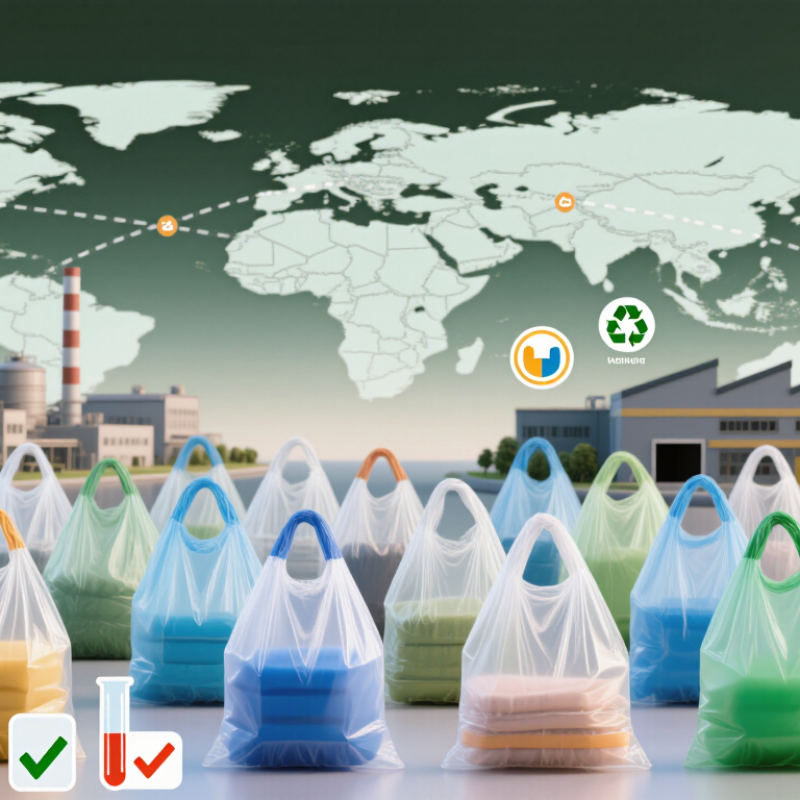
Recycled plastic bags are made from recovered plastic waste, such as used packaging film and post-consumer materials. Manufacturers sort, clean, shred, and melt this material into recycled resin. The resin then becomes film, handles, or woven fabric for new bags. The process sounds simple. It is not.
Global buyers choose these bags to reduce dependence on virgin plastic and support more responsible material use. They also value practical performance. A well-made recycled bag can carry groceries, clothing, promotional items, or industrial goods without feeling weak. During supplier evaluations, buyers often check tensile strength, seam quality, thickness, odor, and color consistency. Clear documentation matters too. Reliable suppliers should explain the recycled content, production controls, and available test records.
Recycled material can vary between production batches. That issue deserves attention. Bags may show slight changes in shade, softness, or surface texture. Buyers should request samples before placing large orders and confirm the intended load capacity. Factory experience shows that attractive samples do not always represent full production quality. Regular inspections, clear specifications, and communication about storage conditions help reduce surprises. Cost, environmental goals, and performance must be considered together, rather than treated as separate purchasing decisions.
| Supplier Capability or Bag Type | Typical Recycled Feedstock | Indicative Recycled Content | Key Performance Characteristics | Common Global Buyer Applications | Important Buyer Requirements | Relevant Documentation or Standards |
|---|---|---|---|---|---|---|
| Recycled LDPE Film Bags | Post-consumer or post-industrial low-density polyethylene film waste | Approximately 30%–100%, depending on appearance, strength, and end-use requirements | Flexible, lightweight, moisture-resistant, and suitable for film conversion; higher recycled content may increase color variation or reduce consistency | Retail carry bags, garment packaging, mailers, produce bags, and general-purpose packaging | Request film thickness, tensile strength, elongation, seal strength, odor limits, and color tolerance | Recycled-content declaration, batch traceability, technical data sheet, and test reports for the finished bag |
| Recycled HDPE Bags | Recovered high-density polyethylene containers, films, and industrial packaging | Approximately 30%–100%, subject to mechanical-performance targets | Higher stiffness and puncture resistance than LDPE; generally suitable for thin-film and heavy-duty bag formats | Shopping bags, refuse sacks, industrial liners, agricultural packaging, and logistics bags | Confirm load capacity, puncture resistance, tear resistance, handle strength, and thickness uniformity | Material identification, recycled-content verification, quality-control records, and applicable packaging compliance documents |
| Post-Consumer Recycled (PCR) Plastic Bags | Plastic collected after consumer use, such as discarded film, containers, or packaging | Project-specific; the exact percentage should be stated in the product specification | Supports waste diversion and circular-material claims; color, odor, and mechanical properties can vary with feedstock quality | Retail packaging, e-commerce mailers, promotional bags, and consumer goods packaging | Require a clear distinction between post-consumer and post-industrial content, along with chain-of-custody evidence | Recycled-content verification, mass-balance or physical-traceability records where applicable, and claim substantiation |
| Post-Industrial Recycled Plastic Bags | Production scrap and unused material recovered before reaching consumers | Often higher and more consistent than mixed PCR content, depending on the manufacturing process | Usually offers more predictable color and processing performance; it does not represent material recovered after consumer use | Industrial liners, internal packaging, warehouse bags, and applications requiring stable specifications | Ask for the source of the scrap, segregation method, recycled-content percentage, and contamination controls | Supplier declaration, production records, material test reports, and documented terminology distinguishing post-industrial content |
| Recycled Drawstring or Refuse Bags | Recycled polyethylene film or mixed compatible polyethylene streams | Commonly specified by the buyer according to required load and leak-resistance performance | Designed for tear resistance, sealing reliability, flexibility, and controlled elongation; performance depends heavily on formulation and thickness | Household waste collection, commercial waste handling, office use, and facility management | Specify bag volume, dimensions, gauge, star or flat seal, drawstring strength, leak resistance, and odor requirements | Finished-product performance testing, recycled-content evidence, packaging safety documentation, and shipment inspection records |
| Recycled E-Commerce Mailers | Recycled polyethylene film, usually processed into flexible multilayer or monolayer mailer film | Varies by required opacity, tear resistance, printing quality, and sealing performance | Lightweight, water-resistant, tamper-evident options available; suitable recycled content must be balanced with film strength | Apparel, books, small consumer products, subscription shipments, and fulfillment operations | Check tear resistance, seal integrity, adhesive performance, print adhesion, opacity, dimensions, and opening features | Technical specification, recycled-content claim support, packaging tests, artwork approval, and pre-shipment inspection |
| Recycled Woven PP Bags | Recycled polypropylene from industrial sacks, woven packaging, and other compatible PP products | Determined by required seam strength, load rating, surface finish, and product-contact conditions | High strength-to-weight ratio, resistance to repeated handling, and suitability for large or heavy contents | Bulk commodities, agricultural products, construction materials, minerals, and industrial goods | Confirm fabric denier, grammage, safe working load, seam construction, liner requirements, and closure type | Load testing, material composition statement, recycled-content records, and product-specific compliance documentation |
| Printed Recycled Plastic Bags | Recycled LDPE, HDPE, or compatible polyethylene film prepared for flexographic or other approved printing processes | Depends on the film grade and print-quality requirements | Can provide branding and handling information while reducing reliance on virgin resin; recycled films may require tighter color control | Retail packaging, promotional distribution, apparel packaging, and event materials | Approve color standards, artwork, ink adhesion, print coverage, barcode readability, and rub resistance before mass production | Artwork proof, color approval, ink compliance declaration, recycled-content documentation, and production inspection report |
| Food-Contact Recycled Plastic Bags | Only recycled material streams and processes permitted for the intended food-contact market | Must be established according to the applicable jurisdiction, polymer type, decontamination process, and intended use | Requires stricter control of contamination, migration, odor, and traceability than general-purpose packaging | Food liners, produce packaging, dry-food packaging, and food-service applications where legally permitted | Confirm legal suitability for the destination market, temperature limits, food type, contact duration, and migration requirements | Food-contact declaration, migration testing, process-control records, and compliance documentation for the destination country |
| Compostable Bags Containing Recycled Plastic | Generally not compatible with conventional plastic recycling streams; claims must be assessed separately from recycled-content claims | Should not be assumed to contain recycled plastic unless the supplier provides specific, verifiable evidence | Compostability and recycled content are different attributes; end-of-life performance depends on certified material composition and conditions | Organic-waste collection, food-service applications, and controlled composting systems where permitted | Do not accept “eco-friendly” wording as proof; verify compostability conditions, local acceptance, thickness, and intended disposal route | Applicable compostability certification, test reports, labeling rules, and clear separation of compostable and recycled-content claims |
Related Posts
-

How to Source Recycled Plastic Bags in 2026
-

Discover the Future of Plastic Bags: 2025 Top Innovations and Trends
-

Top 10 Eco Plastic Innovations Every Buyer Should Know?
-

2026 Best Environmentally Friendly Materials for Sustainable Living?
-
2025 How to Choose the Best Recycled Plastic Bags for Your Needs
-

10 Best Environmentally Friendly Materials for Sustainable Living