
Top 10 Suppliers of Thermal Paper Labels in China?
Choosing a reliable supplier for Thermal Paper Labels in China takes more than comparing unit prices. Label performance depends on the paper coating, adhesive, roll dimensions, and storage conditions. A label that prints clearly in a sample may fade or peel under heat, friction, or humidity. Small details matter.
This guide introduces ten suppliers for buyers to research, not a fixed ranking or endorsement. Supplier capabilities and product ranges can change, so confirm current information directly. Ask for samples that match your intended printer and application. Check print darkness, barcode readability, adhesive performance, core size, roll length, and packaging. If labels will contact food or other sensitive products, request relevant material documentation and assess it with a qualified specialist. Do not assume one specification fits every use.
Look beyond brochures. Compare production experience, quality-control procedures, customization options, communication, and delivery estimates. Request written specifications and clarify how defects or order changes are handled. A clear answer is useful. So is a sample roll. Still, a polished website cannot prove consistent performance across a large order. That is where a buyer’s own testing matters, and it can take time. This list is a starting point, not a shortcut. Use it to build a shortlist, verify claims, and match each supplier to your printer, label design, and operating conditions.
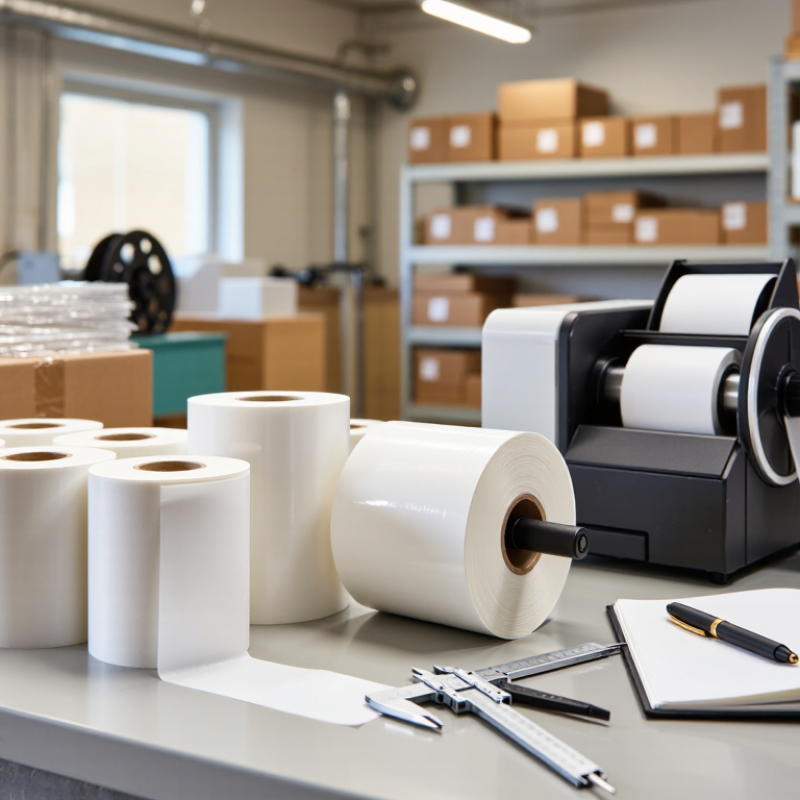
Thermal Paper Labels: Direct-Thermal Imaging and Material Layers
Thermal paper labels create images through direct-thermal imaging. A heated printhead activates a heat-sensitive coating on the paper. Dark marks appear where the printhead applies heat. No ink ribbon is required, which can simplify routine label changes. That matters. Print clarity still depends on printer settings, printhead condition, and the label’s coating quality.
A typical label combines several material layers. The base paper provides structure, while the thermal layer reacts to heat. A topcoat can help shield the image from friction, moisture, or oils. Beneath the paper, pressure-sensitive adhesive holds the label in place, and a release liner protects it before use. Layer balance affects feeding, sticking, and readability. A coating that prints sharply may still disappoint if the adhesive lifts from a cold carton.
When comparing suppliers in China, ask for samples made with the intended printer and application surface. Check small text, barcodes, and image density, then rub the printed area gently. Store another sample near the actual workplace conditions; heat and sunlight can cause fading. Test it. I would not rely on a specification sheet alone, though sample results can vary between batches. Request details about paper weight, coating, adhesive type, and inspection practices, and confirm these against your own use.
Thermal Paper Label Materials: A Representative Layer Build
Illustrative basis weights for a pressure-sensitive direct-thermal label construction. Actual specifications vary by product and application; the thermal imaging coating is part of the face stock and is not shown as a separate weight.
Basis weight is measured in grams per square metre (g/m²). Direct-thermal labels form images when heat activates the coating on the face stock.
Core Specifications: Grammage (g/m²), Caliper (µm), Adhesive, and Liner
When comparing thermal paper label suppliers in China, specify the face stock, adhesive, and liner separately. A practical starting range is 60–80 g/m² for thermal paper and roughly 55–75 µm for caliper; these are buying benchmarks, not universal limits. ISO 536:2019 provides the grammage test method, while ISO 534:2011 covers paper thickness. Ask suppliers to state their test conditions, since pressure and moisture can affect readings.
Adhesive choice depends on the surface and service temperature. Acrylic often suits longer-term applications, while hot-melt can provide strong initial tack on cartons. Request peel and tack results using consistent methods; FINAT FTM 1 and FTM 2 cover peel adhesion and loop tack. The liner matters, too. A glassine liner around 55–80 g/m² is common, but stiffness and dispensing speed may matter more than grammage alone. Check release performance on the intended applicator. Small differences show up fast.
For a supplier shortlist, request a technical data sheet, sample rolls, and batch-to-batch tolerances. Compare actual caliper and grammage against ISO methods, then test print darkness, adhesive transfer, and label lift after application. I would not accept “standard grade” as a specification. It sounds convenient, but it leaves too much room for mismatch. FINAT test methods and ISO measurement standards offer useful common reference points; neither replaces testing on the real package.
China’s Top 10 Thermal Label Suppliers: Company Profiles and Product Lines
China’s thermal-label suppliers span paper coating, converting, and export-focused manufacturing. Grand View Research valued the global thermal paper market at USD 4.4 billion in 2023 and projected a 5.7% annual growth rate through 2030. That figure covers thermal paper broadly, not labels alone, so it offers context rather than a supplier ranking.
A practical comparison of ten Chinese suppliers should examine their product lines and factory strengths. Common offerings include direct-thermal and thermal-transfer labels, top-coated stock, die-cut rolls, and jumbo rolls for converters. Profiles also differ in adhesive options, roll widths, core sizes, and custom packaging. Some factories emphasize high-volume standard labels; others handle smaller custom runs. Small details matter. A sample roll can reveal coating consistency, edge quality, and print clarity. The comparison is imperfect: public product catalogs rarely show actual production capacity or rejection rates.
Tips: Request samples and a written specification before ordering. Test labels on your own printer and packaging surface. Ask for coating type, adhesive performance, roll dimensions, and batch-quality checks. A low quote may omit useful details. That deserves a second look.
Top 10 Suppliers of Thermal Paper Labels in China? — China’s Top 10 Thermal Label Suppliers: Company Profiles and Product Lines
This anonymized overview compares ten common thermal-label product profiles available from Chinese manufacturers and converters. It is organized by product type, not by verified supplier ranking. Specifications, adhesive performance, and available sizes vary by manufacturer and application.
| Profile | Typical Product Line | Facestock | Adhesive Options | Common Applications | Typical Customization |
|---|---|---|---|---|---|
| 01 — General-purpose direct thermal | Standard direct thermal paper labels for everyday barcode and text printing | Coated direct thermal paper | Permanent acrylic or hot-melt adhesive; removable grades may also be available | Retail price labels, inventory identification, and short-term shipping labels | Roll width, core size, label dimensions, roll count, and perforation |
| 02 — Shipping and logistics | Direct thermal labels designed for parcel identification and distribution workflows | Direct thermal paper, often supplied in larger label formats | Permanent adhesive selected for corrugated cartons and common packaging surfaces | Parcel labels, warehouse picking, and transport documentation | Common shipping-label formats, fanfold or roll supply, and barcode-printing layout |
| 03 — Weigh-scale labels | Thermal labels for weighing, checkout, and product identification systems | Direct thermal paper compatible with weigh-scale printers | Permanent adhesive; formulation depends on the package surface and storage conditions | Grocery produce, deli counters, fresh-food packaging, and weighing stations | Printer-compatible widths, label pitch, roll diameter, and preprinted designs |
| 04 — Removable-label profile | Direct thermal labels intended for temporary identification or repositioning | Direct thermal paper | Removable adhesive, subject to testing on the intended surface | Temporary pricing, short-term organization, and reusable containers | Adhesive strength, label size, roll format, and print layout |
| 05 — Cold-environment profile | Thermal labels specified for chilled products and cold-chain handling | Direct thermal paper or thermal-transfer-compatible facestock, depending on the required durability | Cold-temperature adhesive grades may be specified for application to chilled surfaces | Refrigerated food, cold storage, and temperature-controlled distribution | Application temperature, service conditions, face material, and adhesive selection |
| 06 — Synthetic thermal profile | Thermal-printable labels requiring greater resistance than ordinary paper labels | Thermal-coated synthetic film, such as a compatible polypropylene-based facestock | Permanent adhesive options selected for the target substrate | Product identification exposed to moisture, handling, or abrasion | Film thickness, label dimensions, finish, and roll configuration |
| 07 — Ticket and tag profile | Thermal paper tickets, tags, and non-adhesive printed stock | Direct thermal paper supplied as rolls, fanfold stock, or cut formats | Usually non-adhesive; adhesive-backed versions depend on the end use | Queue tickets, event or service tickets, and point-of-sale printing | Paper width, roll length, core size, perforation, and printed numbering |
| 08 — Preprinted thermal profile | Thermal labels with fixed artwork or variable-data areas | Direct thermal paper or another print-compatible label facestock | Permanent or removable grades, depending on the application | Retail labels, branded packaging workflows, and compliance-oriented layouts | Preprinted colors, logos supplied by the buyer, blank print zones, and custom die cuts |
| 09 — Small-format barcode profile | Narrow or compact thermal labels for product and component identification | Direct thermal paper; synthetic options may be specified for added durability | Permanent adhesive commonly used for small-item attachment | Small products, electronic components, laboratory items, and asset identification | Small label dimensions, gap or black-mark sensing, and printer-specific roll setup |
| 10 — Custom-converting profile | Made-to-order thermal label rolls produced to a buyer’s drawing or specification | Paper or compatible synthetic facestock, selected for printing and service conditions | Permanent, removable, or application-specific adhesive options | Specialized packaging, manufacturing, warehousing, and retail systems | Die-cut shape, core and roll dimensions, winding direction, liner, and packaging format |
Supplier Comparison: Roll Width, Minimum Order Quantity, and Lead Time
Top 10 Suppliers of Thermal Paper Labels in China?
Supplier Comparison: Roll Width, Minimum Order Quantity, and Lead Time
When comparing thermal paper label suppliers in China, match roll width to your printer and application. Common requests may include 40 mm, 50 mm, or 80 mm rolls, but confirm usable width, core diameter, and roll length in writing. A sample roll can reveal curling, uneven edges, or poor feeding before a larger order. Small details matter.
Minimum order quantity (MOQ) can vary by material, adhesive, and custom dimensions. Ask whether the quoted MOQ applies to standard stock or made-to-order labels. A low MOQ may carry a higher unit price, while a larger run can leave you with excess inventory. Request pricing at two or three quantities, and compare the same specifications across suppliers. The cheapest quote is not always the easiest to reorder.
Quality Testing: Grammage (ISO 536), Caliper (ISO 534), and Peel (ASTM D3330)
For thermal paper labels, quality checks should begin with the paper itself, not just the printed image. ISO 536 defines how to determine grammage in grams per square metre; ISO 534 covers paper and board thickness. These values help buyers compare rolls and spot uneven stock. A sample can look smooth yet vary across its width. That matters. Record multiple readings, the sampling locations, and the test conditions rather than reporting one convenient result.
Peel strength needs equal care. ASTM D3330/D3330M describes pressure-sensitive adhesive peel tests, including controlled-angle methods. Results depend on the test surface, peel angle, speed, and dwell time, so a number without those details is hard to interpret. For incoming inspection, test labels on the intended packaging surface and compare results with the purchase specification. A peel value from stainless steel may not predict adhesion to a dusty carton. Small difference, big consequence.
Suppliers should provide dated test records that identify the method, sample lot, and individual readings. ISO 536, ISO 534, and ASTM D3330 are useful technical references, but they do not set one universal pass limit for every label application. Buyers must define acceptable ranges for their printers, storage conditions, and use. I would also keep a retained sample from each lot; it is easy to overlook how much humidity changes paper feel.