10 Best Eco Plastic Products for Global Buyers
Global buyers are rethinking plastic without abandoning practicality. Packaging, food-service items, household goods, and industrial components still require strength, hygiene, and reliable pricing. This guide examines 10 eco plastic products that respond to those needs with measurable environmental improvements.
The term eco plastic products covers several materials, including recycled plastic, bio-based polymers, reusable designs, and certified compostable options. Each choice has limits. Recycled content can reduce demand for virgin resin, but supply quality may vary. Compostable packaging may fail without suitable collection facilities. Bio-based plastic is not automatically biodegradable. Context matters.
A responsible buying decision starts with evidence. Product specifications, recycled-content records, third-party certifications, and supplier audits deserve careful review. Relevant standards may differ across countries and end-use sectors. Food-contact products need appropriate safety documentation. Packaging claims should match local labeling rules and disposal systems.
Small details reveal real performance. A reusable container should survive repeated washing. A shipping mailer should resist tearing in wet warehouses. A molded tray should stack efficiently and maintain its shape during transport. Cost per use can matter more than the initial unit price.
Not every greener claim is convincing. Sometimes, the data is incomplete. Buyers should question vague phrases such as “planet friendly” and request lifecycle information where available. The products discussed here offer practical starting points, not perfect answers. Their value depends on design, sourcing, usage, recovery, and honest measurement across the supply chain.
What Makes Eco-Friendly Plastic Products Sustainable
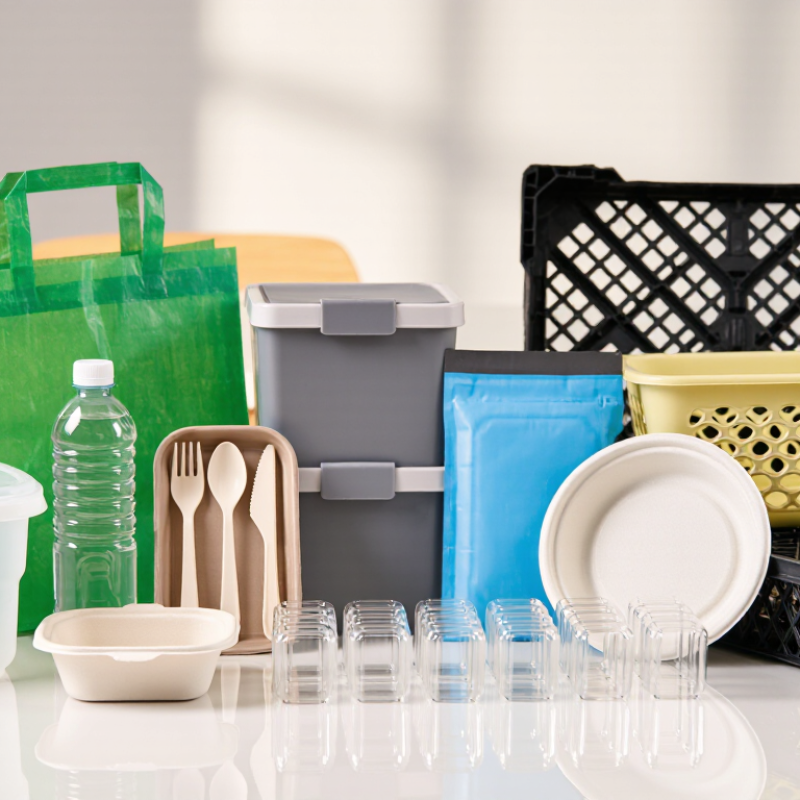
Eco-friendly plastic products are sustainable only when their full life cycle is examined. Material choice alone proves little. A reusable food container needs enough uses to offset its production impacts. The International Energy Agency’s Future of Petrochemicals projected that plastics could account for nearly half of oil demand growth by 2050. That warning makes lightweight design less impressive when disposal remains unchanged. Sustainable products reduce virgin feedstock, energy use, and avoidable waste together.
The OECD’s Global Plastics Outlook (2022) estimated that global plastic waste reached 353 million tonnes in 2019. Only 9% was recycled. These figures expose a practical weakness: recyclable packaging may still be rejected because of dark pigments, mixed layers, food residue, or missing collection systems. Products should use clear material identification, fewer additives, and separable parts. Recycled content matters. Traceable sourcing matters too.
For global buyers, credible evidence includes lifecycle assessments, recycled-content verification, durability testing, and documented end-of-life routes. UNEP’s Turning off the Tap (2023) found that systemic changes could reduce global plastic pollution by 80% by 2040. That is ambitious. It is not automatic. I would also ask whether a compostable item has a suitable industrial composting route nearby. Otherwise, its environmental promise may remain mostly theoretical. The strongest products fit local infrastructure, survive real use, and create less waste after purchase.
10 Best Eco Plastic Products for Global Buyers - What Makes Eco-Friendly Plastic Products Sustainable
| No. | Eco Plastic Product | Primary Feedstock | Main Sustainability Advantage | End-of-Life Route | Typical Applications | Important Buyer Consideration |
|---|---|---|---|---|---|---|
| 1 | Recycled PET (rPET) Bottles and Sheets | Post-consumer PET beverage bottles and other PET packaging | Keeps PET in circulation and reduces demand for virgin resin; PET can be mechanically recycled several times when properly sorted. | Mechanical recycling; chemical recycling is also available in some markets. | Bottles, food trays, thermoformed sheets, fibers, and strapping. | Confirm recycled content, food-contact compliance, contaminant limits, color, and local collection infrastructure. |
| 2 | Recycled HDPE Containers | Post-consumer and post-industrial high-density polyethylene | Uses recovered material while retaining good chemical resistance, impact strength, and processing performance. | Mechanical recycling into new containers, pipes, pallets, or non-food products. | Detergent bottles, personal-care packaging, jerry cans, bins, and pallets. | Recycled resin may have variable color and odor; verify performance and regulatory suitability for the intended contents. |
| 3 | Recycled PP Storage Products | Recovered polypropylene from packaging, automotive parts, and durable goods | Reduces virgin polypropylene demand and supports closed-loop or near-closed-loop applications. | Mechanical recycling, usually after sorting by polymer type and color. | Reusable food containers, household storage boxes, caps, crates, and automotive components. | Check melt-flow rate, impact strength, odor, additive history, and food-contact or safety approvals. |
| 4 | Recycled LDPE and LLDPE Film | Recovered polyethylene bags, stretch film, shrink film, and industrial film waste | Diverts flexible packaging waste from disposal and reduces the need for virgin polyethylene in suitable applications. | Film-to-film recycling where clean, compatible streams are available; otherwise, downcycling is common. | Garbage bags, pallet wrap, agricultural film, mailers, and protective packaging. | Moisture, dirt, multilayer structures, and mixed polymers can reduce recyclability and film quality. |
| 5 | Bio-Based PE Packaging | Renewable plant-based ethanol converted into ethylene and polyethylene | Can reduce dependence on fossil feedstock while providing the same material properties as conventional PE. | Technically recyclable in PE recycling systems; it is not biodegradable. | Bottles, caps, films, flexible pouches, and closures. | Request certified bio-based content and assess land use, feedstock origin, water demand, and recycling access. |
| 6 | Bio-Based PP Products | Renewable biological feedstocks converted into propylene and polypropylene | Offers renewable feedstock potential without changing the core performance of polypropylene products. | Recyclable through polypropylene recycling streams where collection and sorting are available; not biodegradable. | Food containers, caps, appliance parts, automotive components, and reusable products. | Validate bio-based content, supply availability, technical specifications, and compatibility with local recycling systems. |
| 7 | PLA Food-Service Products | Fermented plant sugars, commonly converted into lactic acid and then PLA resin | Uses renewable carbon and can provide clear, rigid packaging for short-life applications. | Generally requires controlled industrial composting conditions; it is not reliably compostable in home compost or natural environments. | Cold-cup lids, clear containers, trays, cutlery, and 3D-printing filament. | Has limited heat resistance and must be clearly labeled to prevent contamination of conventional plastic recycling. |
| 8 | PHA Biodegradable Packaging | Microbially produced polyhydroxyalkanoates from renewable carbon sources | Some PHA grades can biodegrade in a wider range of environments than many other bioplastics, depending on formulation and conditions. | May be suitable for industrial composting and, for certain grades, soil, freshwater, or marine biodegradation claims must be verified separately. | Films, coated paper, food-service items, agricultural products, and specialty packaging. | Performance and degradation rates vary significantly by grade; require independent certification for the target disposal environment. |
| 9 | PBS Compostable Products | Polybutylene succinate made from succinic acid and 1,4-butanediol; feedstocks may be fossil-based or partly bio-based | Provides flexibility and processability for compostable films and molded products when the formulation is certified. | Typically industrial composting; biodegradability depends on the exact grade, thickness, additives, and local conditions. | Shopping bags, food-service items, agricultural films, and flexible packaging blends. | Confirm whether the material is compostable as a finished product rather than only as a resin. |
| 10 | Cellulose-Based Plastic Products | Renewable cellulose from wood pulp, cotton linters, or agricultural residues | Uses a renewable carbon source and can provide transparent films, coatings, and molded items with reduced fossil-plastic content. | Biodegradability and compostability depend on the cellulose derivative, coatings, inks, and additives; recycling may be possible in paper or specialty streams. | Packaging films, eyewear frames, tool handles, coatings, and specialty molded products. | Assess forestry certification, coating chemistry, moisture resistance, compostability evidence, and actual disposal infrastructure. |
Sustainability depends on the complete life cycle, including feedstock sourcing, manufacturing efficiency, product durability, packaging design, collection systems, and verified end-of-life conditions. Compostable does not automatically mean home-compostable or biodegradable in the natural environment.
Related Posts
-
How to Choose Eco Plastic Products for Your Business in 2026?
-
What Is Eco Friendly Plastic and Why Does It Matter?
-
How to Identify and Understand the Recycle Symbol?
-

Innovative Designs and Benefits of Products Made from Recycled Plastic
-
China Top 10 Eco Plastic Products Manufacturers
-

Eco Friendly Furniture Waste Collection Tips for Sustainable Living